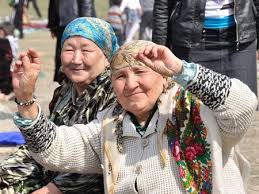
Posts tonen met het label Azerbaijan. Alle posts tonen

donderdag 21 maart 2013

21 March: Holiday Navruz in Central Asia


С Наврузом!

Navruz (also called Noruz, Nowruz, Nowrooz and Nawruz), the spring "New Year" holiday, has been celebrated for at least 2,500 years, and perhaps for as long as 5,000 years. Originating in Persia and long associated with the ancient Zoroastrian religion , its name means "new day" in Farsi because for ancient Persians it marked the first day of the New Year.

On this day, Persian kings would have worn a crown with images of the annual solar cycle on their heads, participated in the divine mass in the Temple of Fire, and distributed generous gifts to citizens.

Today, Navruz is celebrated each year on March 21 , when the sun enters the sign of Aries on the astrological calendar. In the northern hemisphere, this date frequently coincides with the spring equinox, the day on which the number of daylight hours equals the number of nighttime hours.
On the modern Gregorian calendar, the spring equinox varies from March 19 to March 21. Although their calendars were different, ancient peoples followed the course of the sun and moon closely, and knew that the seasons began to change on this date.

As Turks and other nomadic peoples moved into Central Asia and areas around Persia, they adopted the celebration of Navruz. Just as the Saxon holiday of Ostara was embraced by Christianity and become Easter in the West, Navruz traditions, which had grown strong roots in the life of Eurasian farmers and townspeople, survived the coming of Islam to the area 1.400 years ago.

Today, Navrus is celebrated widely and colorfully in Iran, Azerbaijan, Afghanistan, Uzbekistan, Tajikistan, Kyrgyzstan, Kazakhstan, Turkmenistan and the western provinces of China, as well as the Kurds in Turkey, Syria and Iraq and the Tatars and Bashkirs in southern Russia. In the last ten years, the Central Asian republics have recognized Navruz as an official holiday. Its celebration is marked by concerts in parks and squares, trade fairs and national horseracing competitions.
Celebrations of spring are a natural outgrowth of the Earth's rhythms. In most of the Silk Road countries, Navruz announces the joyful awakening of nature after winter and the beginning of the agricultural cycle of cultivating, planting, and harvesting.

March 21 is the main celebration, but for the next 13 days it is common practice to visit friends and relatives, buy and plant seedlings of fruit trees and have cheerful gatherings in the fresh spring air.
Children enjoy the holiday because they often get presents of money, as well as blessings, from their elders.
The activities of the first 13 days of the New Year are considered harbingers of the year to come. For this reason, it is traditional to end quarrels, forgive debts and overlook enmity and insults. It is a time for reconciliation, when forgiveness and cheerfulness are the dominant sentiments.

As with the celebration of the Chinese New Year, there are traditions associated with the first visitor to the house during Navruz. To ensure good luck for the coming year, this person should have a "happy foot"; he or she should be kind, gentle, witty, and pious and have a good reputation.

Central Asia has its own Navruz traditions. From ancient times, the holiday was celebrated in agricultural oases with festivals, bazaars, horseracing, and dog and cock fights. Today, Uzbeks still serve a traditional meal of "sumalyak", which tastes like molasses-flavored cream of wheat and is made from flour and sprouted wheat grains. Sumalyak is cooked slowly on a wood fire, sometimes with the addition of spices. Sprouted grain is a symbol of life, heat, abundance and health.
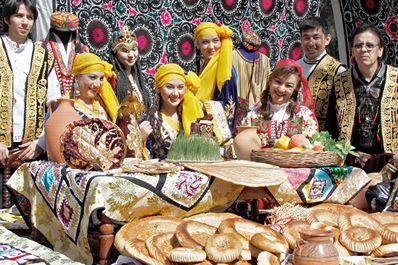
The main holiday dishes for Turkic Central Asians are pilaf (plov), shurpa, boiled mutton and kok-samsa pies filled with spring greens and the young sprouts of steppe grasses. According to tradition, people try to make the celebratory table (dastarkhan) as rich as possible with various dishes and sweets. Everyone at the table should be full and happy to ensure that the coming year will be safe and the crop will be plentiful.
The holiday is accompanied by the competitions of national singers and storytellers, competitions of horsemen and fights between strong men.

Source: Silk road adventures

woensdag 19 september 2012

NATO’s partners in the South Caucasus

On 6 and 7 September NATO’s Secretary General visited the South Caucasus – a region that is strategically important to the Alliance. NATO has been progressively deepening dialogue and cooperation with Armenia, Azerbaijan and Georgia since the early 1990s. All three partners provide valuable support to NATO-led operations, while benefiting from NATO support for security and defence-related capacity building and reform.

The South Caucasus is a crossroads of civilizations, situated between the Black Sea to the west, the Caspian Sea to the east and bordering Turkey, Russia and Iran. The region has been of considerable geostrategic importance through the ages – and continues to be so today.
The region borders the territory of a NATO member state and includes Georgia, a country aspiring to join the Alliance. It also offers useful alternative transit options for the transport of supplies to and from the NATO-led force in Afghanistan.

Shared security concerns

The Allies and their partners in the South Caucasus face the same security challenges, such as terrorism and the proliferation of weapons of mass destruction. Such threats defy borders and can only be addressed effectively through international cooperation.
Energy security is an important security issue of shared concern. The South Caucasus sits on key oil and gas transit routes, and has significant oil and gas reserves. Energy-importing countries are looking to diversify their energy sources and supply routes, while energy-exporting and transit countries need to ensure the security of their industry and pipeline infrastructure.
One serious concern are the protracted conflicts in the region. Following a conflict between ethnic Armenians and Azerbaijanis from 1988 to 1994, the sides agreed a cease fire in May 1994. However, a political settlement still needs to be found. The Abkhazia and South Ossetia regions of Georgia continue to be sources of tension, in particular following the conflict with Russia in August 2008.
NATO does not seek a direct role in the resolution of these conflicts, but supports the efforts of other international organizations, which have specific mandates for their mediation roles.The peaceful resolution of conflict is a core value of NATO and is at the heart of the commitments that NATO’s partners in the South Caucasus undertook when they joined the Partnership for Peace.

Valued support for operations

All three Caucasus partners have provided valuable support for NATO-led operations. Armenia has been contributing troops to the Kosovo Force (KFOR) since 2004. It first deployed personnel in support of the International Security Assistance Force (ISAF) in Afghanistan in 2010 and increased its deployment from 40 to 126 in 2011.
Having actively supported KFOR in the past, Azerbaijan currently has 94 personnel deployed in support of ISAF. The country also supports ISAF’s mission with over-flight rights and has contributed to the development of Afghan national security forces through financial support and training in de-mining.
Today, with around 800 military personnel deployed in Afghanistan, Georgia is the second largest non-NATO ISAF troop contributing nation and planned deployments this autumn will make it the largest. The country also supports Operation Active Endeavour, NATO’s counter-terrorist maritime surveillance operation in the Mediterranean. Georgia also contributed to KFOR in the past.
All three countries are actively working towards the development of units that meet NATO standards and that can in future participate in international peacekeeping operations.

Deepening partnership

Bilateral partnership programmes with NATO allow each of the Caucasus partners to draw on Allied expertise in adapting their defence institutions and capabilities to deal with security challenges. In the past decade, all three countries have chosen to deepen the level of cooperation and tighten the focus on their respective reform priorities.
Armenia and Azerbaijan have both developed Individual Partnership Action Plans with NATO. In the case of Georgia – following a dialogue with the Alliance about its membership aspirations and the declaration by Allies at the 2008 Bucharest Summit that the country will become a member – intensified cooperation is now being taken forward through the unique framework of the NATO-Georgia Commission that was established in September 2008.
Beyond cooperating on security and defence-related capacity building and reform, NATO and its partners in the South Caucasus work together in other areas such as border security, cyber security, and disaster preparedness and response.
Partnership has also brought some tangible benefits for citizens in the Caucasus countries. For example, in Armenia – a country prone to earthquakes – NATO provides training to improve the search-and-rescue capabilities. In Azerbaijan and Georgia, NATO has supported projects to clear and safely dispose of large numbers of dangerous, unexploded and obsolete landmines and munitions.

Source: Nato.int

vrijdag 20 maart 2009

Azerbaijan President Ilham Aliyev to remain in office indefinitely

Azerbaijan’s constitutional referendum featured a Soviet-style result, as election officials claimed that more than nine out of every 10 voters expressed approval for lifting presidential term limits. Overall, the Azerbaijan's Central Elections Commission reported a 71 percent turnout for Wednesday's ballot. Only a 25 percent turnout rate was required for the referendum results to stand. The initiative was proposed in December by the ruling Yeni Azerbaijan (New Azerbaijan) Party, which Aliyev heads. The Azerbaijani constitution limited presidents to two five-year terms.
Opposition members fear that the change could turn Azerbaijan’s presidency into a hereditary position, controlled by the Aliyev family. Already, Azerbaijan has set a precedent for dynastic succession in the former Soviet Union: llham Aliyev was preceded in office by his father, Heidar, who died in 2003 after 10 years as president of Azerbaijan. The elder Aliyev is now portrayed in Azerbaijan as the founding father of the modern Azerbaijani state.
In a March 19 statement, the Parliamentary Assembly of the Council of Europe (PACE) noted that the vote was "transparent, well-organized and held in a peaceful atmosphere."At the same time, PACE took issue with the lack of public debate in the run-up to the referendum. The vote was announced in December, but the official campaign lasted only 28 days. Public television allotted just three hours per week to debates about the various constitutional changes.
Source: EurasiaNet.org