Posts tonen met het label Uzbekistan. Alle posts tonen

donderdag 30 mei 2013

Uzbekistan: Tashkent - Amir Temur

The first days I spent in Tashkent. The city is more than 2000 years old and has changed its name many times during the history: Chach, Shash, Binkent. All of these names can be linked to the Turkish word ¨Tash¨ (stone).

Memorial stone earthquake 1966
Memorial earthquake "Courage"
Unfortunately many of the historical monuments have been destroyed after the revolution of 1917. Only Kukeldash and Barak-Khana Madrassahs (16th century) have been preserved until today. In 1966, a destructive earthquake shook Tashkent and raised half of the city into ruins. 

When I walk on the street with my Russian friends who lived during their youth in Tashkent they tell me a lot has changed and many buildings and zones are completely new; logos, street names and advertisements are again written in Russian, etc. Yet, when I speak with Russians who have stayed after the independence they tell me all good doctors and teachers have left and they themselves are about to leave the country as well in order to offer a better education to their children.

Amir Temur 
All places I visit in Uzbekistan are either connected to the president, either to Amir Temur. Time to tell something more about the Great Amir Temur (Emir Timur).
Amir Temur Square, Tashkent
Amir Temur, also called Tamerlane (or Lame Temur) for his lame right leg, was born in 1336 in Shakhrisabz, a town near to Samarkand. He was the grandfather of Ulugh Beg, who ruled Central Asia from 1411 to 1449, and the great-great-great-grandfather of Babur, founder of the Mughal Empire, which ruled South Asia for centuries.

From his youth he appeared on the political scene as an active politician and military figure. Having become the ruler of Samarkand he built a great army and carried on many annexationist campaigns. Thus he expanded his empire that stretched from the Volga River and the Caucasian ridges in the west to India in the Southwest. But the center of the empire was in Central Asia.

Tamerlane made an outstanding contribution to the national state system, education and culture, and general development of his state. He promoted the construction of monumental historic buildings, especially in Samarkand. Some of them can be seen today. The inscription on the portal of Tamerlane's Palace Ak-Sarai in Shakhrisabz, reads "If you doubt our might, look at our buildings". The impressiveness of the architecture was aimed at the demonstration of the greatness of the empire. All possible means and every effort were exerted to construct these magnificent buildings. A vast range of building materials from neighboring regions, famous architects, suppliers, and a great number of workers were brought to work. Different specialists were taken from occupied lands.

He ruled over an empire that, in modern times, extends from southeastern Turkey, Syria, Iraq, and Iran, through Central Asia encompassing part of Kazakhstan, Afghanistan, Armenia, Azerbaijan,Georgia, Turkmenistan, Uzbekistan, Kyrgyzstan, Pakistan, and even approaches Kashgar in China. (a full description of his conquests can be found here).

Temur planned to conquer China and to this end, Temur made an alliance with the Mongols of the Northern Yuan Dynasty and prepared all the way to Bukhara. In December 1404, Temur started military campaigns against the Ming Dynasty and detained a Ming envoy, but he was attacked by fever and plague when encamped on the farther side of the Sihon (Syr-Daria) and died at Atrar (Otrar) on 17 February 1405, without ever reaching the Chinese border. Although he preferred to fight his battles in the spring, Temur died during an uncharacteristic winter campaign against the ruling Chinese Ming Dynasty. It was one of the bitterest winters on record.

Temur's legacy is a mixed one. While Central Asia blossomed under his reign, other places such as Baghdad, Damascus, Delhi and other Arab, Georgian, Persian and Indian cities were sacked and destroyed and their populations massacred. He was responsible for the effective destruction of the Christian Church in much of Asia. Thus, while Temur still retains a positive image in Muslim Central Asia and Persia, he is vilified by many in Arabia and India, where some of his greatest atrocities were carried out.

Amir Temur Hiyoboni  
Amir Temur Square, Tashkent
In Tashkent the central square is called after Amir Temur. It was firstly designed in 1870 by Imperial Russian architects as a central park of the new Tashkent and called Constantine Square. Since then the main monument in the center of the square was changed several times. The first was one to General Kaufmann later replaced by monument to Free Workers (1917), monument to 10th anniversary to October revolution (1927), monument to Stalin (1947) and later a monument to Karl Marx (1968). Since 1993, the monument to Amir Temur stands in the center of the square and has Amir's name.

Uzbekistan: Getting there

From Europe there are flights to Uzbekistan offered by Uzbekian Airways, Turkish Airlines, Czech Airlines and Aeroflot. As the flight schedule of Aeroflot suits my program the best and offers the best price, I decide to fly with Aeroflot. I flew before with Aeroflot and I have always been very pleased with the service they offer. Also this time the service was excellent. I made a stopover in Moscow (even left the airport building) and my luggage was delivered without any problems at the airport of Tashkent.

In order to leave the airport in Moscow one has to fill in a Immigration Card which these days is filled in automatically at the passport control (so not anymore at the plane) and if not more than 10000 Euro is imported, the Customs declaration doesn't has to be filled in.

In Tashkent however, the Customs Declaration still has to be filled in. I only found the Customs Declaration in Russian (though I suppose it also exists in English and/or Uzbek) but don't count on English speaking staff. 

Once passed the passport control, local people start offering their services to bring you to town by car. A ride to the town centre shouldn't cost more than 5000 SUM. It’s a good moment to start learning how to haggle and get a reasonable (tourist) price.

zaterdag 11 mei 2013

Uzbekistan: country profile

The republic of Uzbekistan is the only double landlocked country in Central Asia and one of only two such countries worldwide. It shares borders with Kazakhstan to the west and to the north, Kyrgyzstan and Tajikistan to the east, and Afghanistan and Turkmenistan to the south. Before 1991, it was part of the Soviet Union. Most of Uzbekistan territory of 447,400 square kilometres lies between the two major rivers of Central Asia, the Syr Darya (Jaxartes) and the Amu Darya (Oxus). The highest point in Uzbekistan is the Khazret Sultan (4643 m), in the southern part of the Gissar Range in Surkhandarya Province, on the border with Tajikistan, just northwest of Dushanbe.


Grotere kaart weergeven

Once part of the Persian Samanid and later Timurid empires, the region was conquered in the early 16th century by nomads who spoke an Eastern Turkic language. Most of Uzbekistan’s population today belong to the Uzbek ethnic group and speak the Uzbek language. Uzbekistan was incorporated into the Russian Empire in the 19th century, and in 1924 became a constituent republic of the Soviet Union, known as the Uzbek Soviet Socialist Republic (Uzbek SSR). It became independent on 31 August 1991.
The country is one of the world's biggest producers of cotton and is rich in natural resources, including oil, gas and gold. However, economic reform has been slow and poverty and unemployment are widespread.
Following the 11 September attacks on the US, Uzbekistan won favour with Washington by allowing its forces a base in Uzbekistan, affording ready access across the Afghan border.
Human rights groups accused the international community of ignoring the many reported cases of abuse and torture.

Climate

The climate of Uzbekistan is extremely continental with a great number of sunny days. The average monthly temperature in January ranges from -10°C to 3°C. Summers are hot and dry (35°C-45°C) with the so called Chillya, from 25 June until 5 August, the hotest period.

Uzbekistan currency

All payments are made in 'Sum', the national currency of the Republic of Uzbekistan.
1 EUR = 2698 SUM


donderdag 21 maart 2013

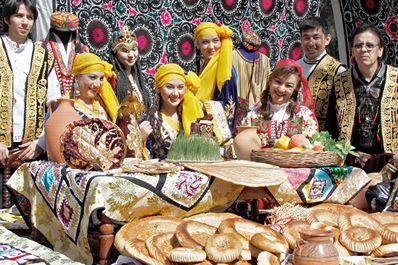
21 March: Holiday Navruz in Central Asia


С Наврузом!

Navruz (also called Noruz, Nowruz, Nowrooz and Nawruz), the spring "New Year" holiday, has been celebrated for at least 2,500 years, and perhaps for as long as 5,000 years. Originating in Persia and long associated with the ancient Zoroastrian religion , its name means "new day" in Farsi because for ancient Persians it marked the first day of the New Year.

On this day, Persian kings would have worn a crown with images of the annual solar cycle on their heads, participated in the divine mass in the Temple of Fire, and distributed generous gifts to citizens.

Today, Navruz is celebrated each year on March 21 , when the sun enters the sign of Aries on the astrological calendar. In the northern hemisphere, this date frequently coincides with the spring equinox, the day on which the number of daylight hours equals the number of nighttime hours.
On the modern Gregorian calendar, the spring equinox varies from March 19 to March 21. Although their calendars were different, ancient peoples followed the course of the sun and moon closely, and knew that the seasons began to change on this date.

As Turks and other nomadic peoples moved into Central Asia and areas around Persia, they adopted the celebration of Navruz. Just as the Saxon holiday of Ostara was embraced by Christianity and become Easter in the West, Navruz traditions, which had grown strong roots in the life of Eurasian farmers and townspeople, survived the coming of Islam to the area 1.400 years ago.

Today, Navrus is celebrated widely and colorfully in Iran, Azerbaijan, Afghanistan, Uzbekistan, Tajikistan, Kyrgyzstan, Kazakhstan, Turkmenistan and the western provinces of China, as well as the Kurds in Turkey, Syria and Iraq and the Tatars and Bashkirs in southern Russia. In the last ten years, the Central Asian republics have recognized Navruz as an official holiday. Its celebration is marked by concerts in parks and squares, trade fairs and national horseracing competitions.
Celebrations of spring are a natural outgrowth of the Earth's rhythms. In most of the Silk Road countries, Navruz announces the joyful awakening of nature after winter and the beginning of the agricultural cycle of cultivating, planting, and harvesting.

March 21 is the main celebration, but for the next 13 days it is common practice to visit friends and relatives, buy and plant seedlings of fruit trees and have cheerful gatherings in the fresh spring air.
Children enjoy the holiday because they often get presents of money, as well as blessings, from their elders.
The activities of the first 13 days of the New Year are considered harbingers of the year to come. For this reason, it is traditional to end quarrels, forgive debts and overlook enmity and insults. It is a time for reconciliation, when forgiveness and cheerfulness are the dominant sentiments.

As with the celebration of the Chinese New Year, there are traditions associated with the first visitor to the house during Navruz. To ensure good luck for the coming year, this person should have a "happy foot"; he or she should be kind, gentle, witty, and pious and have a good reputation.

Central Asia has its own Navruz traditions. From ancient times, the holiday was celebrated in agricultural oases with festivals, bazaars, horseracing, and dog and cock fights. Today, Uzbeks still serve a traditional meal of "sumalyak", which tastes like molasses-flavored cream of wheat and is made from flour and sprouted wheat grains. Sumalyak is cooked slowly on a wood fire, sometimes with the addition of spices. Sprouted grain is a symbol of life, heat, abundance and health.

The main holiday dishes for Turkic Central Asians are pilaf (plov), shurpa, boiled mutton and kok-samsa pies filled with spring greens and the young sprouts of steppe grasses. According to tradition, people try to make the celebratory table (dastarkhan) as rich as possible with various dishes and sweets. Everyone at the table should be full and happy to ensure that the coming year will be safe and the crop will be plentiful.
The holiday is accompanied by the competitions of national singers and storytellers, competitions of horsemen and fights between strong men.

Source: Silk road adventures

donderdag 6 november 2008

Press release 2897th meeting of the Council General Affairs and External Relations

Conclusies bijeenkomst Raad van Ministers van 15 september over Wit-Rusland, Oezbekistan en Georgië
The Council noted with satisfaction that, following the deployment by the EU of a civilian observer mission in Georgia, Russian troops had withdrawn from the zones adjacent to South Ossetia and Abkhazia. This was an additional step in the implementation of the agreements of 12 August and 8 September, which were concluded with the mediation of the European Union following the conflict last summer. The Council reaffirmed the willingness of the EU to take an active part in the international discussions on Georgia, which are set to commence on 15 October in Geneva under the auspices of the EU, the UN and the OSCE. These discussions must focus on all the remaining problems, in particular that concerning arrangements for security and stability in the region and the urgent question of displaced persons. The Council further noted with satisfaction that some progress had been made, compared with previous elections, during the recent electoral campaign in Belarus, even though the parliamentary elections held on 28 September failed to meet the democratic criteria of the OSCE. In this context, it hoped for gradual re-engagement with this country and decided to restore the contacts which it had restricted in November 2004. A meeting between the Council troika and the Belarusian Minister for Foreign Affairs took place in the margins of the meeting. Moreover, in order to encourage dialogue with the Belarusian authorities and the adoption of measures to strengthen democracy and respect for human rights, the Council decided that the travel restrictions currently imposed on certain leading figures would not apply for a period of six months which may be reviewed. At the end of that period, the Council will reconsider the situation in the light of the progress made by the Belarusian authorities. In the case of Uzbekistan, the Council welcomed the progress achieved in the last year with regard to respect for the rule of law and the protection of human rights, while remaining concerned about the situation in some domains. It called on the Uzbek authorities to fulfil all their obligations in this respect and is prepared to assist Uzbekistan in its reforming efforts. In this context, it decided not to renew the travel restrictions applying to certain individuals, which had been suspended in October 2007 and April 2008, but would be renewing the arms embargo for a period of 12 months.