donderdag 9 mei 2013

9 May: Victory Day in Russia

Yesterday the Centro Ruso de Ciencia y Cultura in Madrid opened a photo exhibition, dedicated to the 68th anniversary of the Victory Day in Russia, which will take place until 14 May. Victory Day marks Germany’s surrender to the Soviet Union in 1945. It became the end of the Great Patriotic War for the USSR, which lost about 25 million citizens in the four years of fighting.

Many people attend a local military parade and watch the fireworks at night on Victory Day. The biggest parade is in Moscow’s Red Square, showcasing Russia’s military forces. Most veterans wear their medals as they head to the parade or an event organized by a local veteran organization.
Another tradition is to give flowers, usually red carnations, to veterans in the street and to lay wreaths at the war memorial sites. Neighborhood schools may host a program prepared by the students, featuring wartime songs and poetry.
At home, families gather around a festive table to honor surviving witnesses of World War II and remember those who passed away. They may also watch a favorite Soviet film based on the events of World War II, which is also known as the Great Patriotic War.


donderdag 21 maart 2013

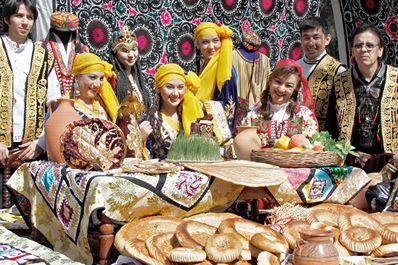
21 March: Holiday Navruz in Central Asia


С Наврузом!

Navruz (also called Noruz, Nowruz, Nowrooz and Nawruz), the spring "New Year" holiday, has been celebrated for at least 2,500 years, and perhaps for as long as 5,000 years. Originating in Persia and long associated with the ancient Zoroastrian religion , its name means "new day" in Farsi because for ancient Persians it marked the first day of the New Year.

On this day, Persian kings would have worn a crown with images of the annual solar cycle on their heads, participated in the divine mass in the Temple of Fire, and distributed generous gifts to citizens.

Today, Navruz is celebrated each year on March 21 , when the sun enters the sign of Aries on the astrological calendar. In the northern hemisphere, this date frequently coincides with the spring equinox, the day on which the number of daylight hours equals the number of nighttime hours.
On the modern Gregorian calendar, the spring equinox varies from March 19 to March 21. Although their calendars were different, ancient peoples followed the course of the sun and moon closely, and knew that the seasons began to change on this date.

As Turks and other nomadic peoples moved into Central Asia and areas around Persia, they adopted the celebration of Navruz. Just as the Saxon holiday of Ostara was embraced by Christianity and become Easter in the West, Navruz traditions, which had grown strong roots in the life of Eurasian farmers and townspeople, survived the coming of Islam to the area 1.400 years ago.

Today, Navrus is celebrated widely and colorfully in Iran, Azerbaijan, Afghanistan, Uzbekistan, Tajikistan, Kyrgyzstan, Kazakhstan, Turkmenistan and the western provinces of China, as well as the Kurds in Turkey, Syria and Iraq and the Tatars and Bashkirs in southern Russia. In the last ten years, the Central Asian republics have recognized Navruz as an official holiday. Its celebration is marked by concerts in parks and squares, trade fairs and national horseracing competitions.
Celebrations of spring are a natural outgrowth of the Earth's rhythms. In most of the Silk Road countries, Navruz announces the joyful awakening of nature after winter and the beginning of the agricultural cycle of cultivating, planting, and harvesting.

March 21 is the main celebration, but for the next 13 days it is common practice to visit friends and relatives, buy and plant seedlings of fruit trees and have cheerful gatherings in the fresh spring air.
Children enjoy the holiday because they often get presents of money, as well as blessings, from their elders.
The activities of the first 13 days of the New Year are considered harbingers of the year to come. For this reason, it is traditional to end quarrels, forgive debts and overlook enmity and insults. It is a time for reconciliation, when forgiveness and cheerfulness are the dominant sentiments.

As with the celebration of the Chinese New Year, there are traditions associated with the first visitor to the house during Navruz. To ensure good luck for the coming year, this person should have a "happy foot"; he or she should be kind, gentle, witty, and pious and have a good reputation.

Central Asia has its own Navruz traditions. From ancient times, the holiday was celebrated in agricultural oases with festivals, bazaars, horseracing, and dog and cock fights. Today, Uzbeks still serve a traditional meal of "sumalyak", which tastes like molasses-flavored cream of wheat and is made from flour and sprouted wheat grains. Sumalyak is cooked slowly on a wood fire, sometimes with the addition of spices. Sprouted grain is a symbol of life, heat, abundance and health.

The main holiday dishes for Turkic Central Asians are pilaf (plov), shurpa, boiled mutton and kok-samsa pies filled with spring greens and the young sprouts of steppe grasses. According to tradition, people try to make the celebratory table (dastarkhan) as rich as possible with various dishes and sweets. Everyone at the table should be full and happy to ensure that the coming year will be safe and the crop will be plentiful.
The holiday is accompanied by the competitions of national singers and storytellers, competitions of horsemen and fights between strong men.

Source: Silk road adventures

maandag 11 maart 2013

11 марта 2013: Сегодня начинается масленичная неделя

В понедельник, 11 марта, начинается масленичная неделя - подготовительная к Великому посту - в этом году она пройдет с 11 по 17 марта. Срок проведения Масленицы зависит от даты главного христианского праздника - Пасхи. По православным пасхалиям празднование Масленицы начинается за 56 дней до Пасхи, что соответствует второй половине февраля - началу марта. В этом году масленичная неделя, как и Пасха (5 мая), будет "поздней".
Вместе с тем, Масленица - древний славянский праздник, пришедший к нам из языческой культуры и сохранившийся после принятия христианства. Церковь включила Масленицу в число своих праздников, назвав его Сырной, или Мясопустной неделей, так как Масленица приходится на неделю, предшествующую Великому посту.

Название и суть масленицы
Масленица - название, которое указывает на пищу, разрешенную в последнюю неделю перед Великим постом, который в этом году наступает 18 марта. Древняя византийская традиция говорит о "сырной седмице" (неделе) перед постом, но на Руси, когда на ее земли пришло христианство, больше употребляли другие молочные продукты, из которых самым похожим на сыр было масло.
Нехристианские традиции славянской масленицы восходят к языческим обычаям, связанным с проводами зимы и встречей весны.

Традиции празднования масленицы
В странах восточной Европы масленица на протяжении многих веков сохранила характер народного гулянья. Масленицу встречали с величальными песнями на снежных горках. Символом Масленицы было чучело из соломы, обряженное в женские одежды, с которым вместе веселились, а затем хоронили или сжигали на костре вместе с блином, которое чучело держало в руке.
Неотъемлемой частью праздника были катания на лошадях, на которых надевали лучшую сбрую. Парни, которые собирались жениться, специально к этому катанию покупали сани. В катанье непременно участвовали все молодые парочки. Также широко, как и праздничная езда на лошадях, распространено было катание молодежи с ледяных гор. Среди обычаев сельской молодежи на Масленицу были также прыжки через костер и взятие снежного городка. Основным угощением Масленицы являлись блины, вся же неделя на масленицу именовалась не иначе как "честная, широкая, веселая, боярыня-масленица, госпожа масленица".
С христианизацией Руси блины, когда-то воспринимавшиеся как языческий символ солнца, стали просто традиционной праздничной пищей в "сырную неделю", как куличи и пасха в праздник Воскресения Христова.

Религиозная суть праздника
По церковному учению, во время масленичных встреч и празднований люди должны найти возможность примириться, если они были в ссоре или вражде, обновить родственные, дружеские связи и простить обиды друг другу. Не случайно кульминация масленицы наступает в Прощеное воскресенье (в этом году 17 марта), им масленица и завершается.
В Прощеное воскресенье в храмах после вечернего богослужения совершается особый церковный чин прощения, а в течение дня верующие традиционно просят друг у друга прощения за все, чем могли обидеть, чтобы вступить в Великий пост с чистой душой, примирившись со всеми.

Source: Korrespondent.net

donderdag 7 maart 2013

8 March: International Women's day


In 1913 Russian women observed their first International Women's Day on the last Sunday in February (by Julian calendar then used in Russia). In 1917 demonstrations marking International Women's Day in Saint Petersburg on the last Sunday in February (which fell on 8 March on the Gregorian calendar) initiated the February Revolution.

Following the October Revolution, the Bolshevik Alexandra Kollontai persuaded Vladimir Lenin to make it an official holiday in the Soviet Union, and it was established, but was a working day until 1965. On May 8, 1965 by the decree of the USSR Presidium of the Supreme Soviet International Women's Day was declared a non-working day in the USSR “in commemoration of the outstanding merits of Soviet women in communistic construction, in the defense of their Fatherland during the Great Patriotic War, in their heroism and selflessness at the front and in the rear, and also marking the great contribution of women strengthening friendship between peoples, and the struggle for peace.”

March 8th is an official public holiday. This beautiful spring holiday is most often celebrated in the family circle with a festive meal and champagne. Another popular choice to celebrate March 8th is by visiting friends. Men and women give flowers, postcards with poetry, chocolate, and other pleasant gifts to their mothers, wives, grandmothers, sisters and daughters.

Since the International Women's Day is a non-working day in Russia, office workers celebrate it just the day before the holiday. In companies and organizations, all women receive flowers and small memorable gifts from their male co-workers and, sometimes, from employers themselves. During the lunch break, it is common to have a small office party with cake and a glass of champagne.

The website masterrussian.com gives some tips about what to give as a gift on March 8th.
Both men and women make presents to women they are close to. The gifts that Russians give on March 8th depend on many factors. A few things to consider are how closely you are related to a woman (whether she's your grandmother, mother, wife, or a girlfriend) and what kind of a gift you can afford financially.
Flowers are the most popular gift choice on March 8th. Yellow mimosas and roses are especially popular. Candy and chocolate are the next popular choice, followed by perfume and cosmetics. Some people like to give money or gift cards, so that women could pick the best present for themselves. The list goes on and other gift choices include jewelry, household appliances, kitchen utensils, cut glass and China, clothes, footwear, books, DVDs, and even cell phones and cameras. Tastes differ but the rule of thumb is to give something that will please the woman.

It’s not required to buy an expensive gift to show that you care about a person. Many women will be pleased to receive a postcard with a poem and a few words of congratulations. Even if you are away from your wife, mother, grandmother or sister, you can always send her a postcard or write an email. Here are some Russian poems that you can use on the occasion of March 8th. 

- 1 -
Желаю счастья и любви.
Они дороже всех подарков.
И пусть все сбудутся мечты
В прекрасный день - 8 Марта!
- 2 -
Я тебя поздравляю, с праздником светлой Весны!
Радости, счастья желаю, сладкие видеть сны!
Пусть все невзгоды, ненастья, обходят тебя стороной!
Ведь это ж большое счастье, что встретились мы с тобой!
- 3 -
Пусть в этот день весенними лучами
Вам улыбнутся люди и цветы,
И пусть всегда идут по жизни с Вами
Любовь, здоровье, счастье и мечты!
- 4 -
С душистой веточкой сирени
Весна приходит в каждый дом,
От всей души Вас поздравляем
С Международным Женским днём!
 Source: Masterinrussian.com

zaterdag 23 februari 2013

El 23 de febrero: una fiesta para los hombres

Se celebra el Día del Defensor de la Patria, aunque de manera no oficial se considera el “Día de los hombres”, y estos suelen recibir regalos, independientemente si han servido o no en el ejército. ¿Por qué se celebra este día? 

A diferencia del Día Internacional de la Mujer, que llegó a Rusia por Occidente, el Día del Defensor de la Patria es una 'invención' plenamente rusa.
Sin embargo, por ahora no existe una opinión unánime sobre el por qué se eligió precisamente la fecha del 23 de febrero. De acuerdo con el punto de vista oficial, elaborado en la Unión Soviética en los años 20, en este día del año 1918 las tropas del Ejército Rojo derrotaron a las tropas alemanas cerca de Pskov y Narva.

Pero más adelante, habiendo estudiado detalladamente los documentos de aquella época, los historiadores desmintieron este hecho: de acuerdo con los datos de archivo, la noche del 23 de febrero los alemanes se encontraba a 55 kilómetros de Pskov y a 170 de Narva y no hay batalla alguna registrada, ni en los archivos alemanes ni en los rusos.
Aun así, en menos de veinte años este mito consiguió arraigar y durante los años de la Segunda Guerra Mundial, el 23 de febrero se celebró de forma generalizada precisamente como el día de las primeras victorias del Ejército Rojo sobre los alemanes.
Desde entonces y hasta ahora la fecha de la fiesta se ha mantenido, si bien ha cambiado de nombre en varias ocasiones.
Hasta 1949 en la Unión Soviética se celebró el Día del Ejército Rojo y, del 1949 al 1996, la fiesta se llamó oficialmente el Día del Ejército Soviético y de la Armada, después de lo cual pasó a llamarse Día del Ejército Ruso, primero, y, dos años después, Día del Defensor de la Patria.

A pesar de que en un principio esta fiesta no tenía relación alguna con el Día Internacional de la Mujer, con el tiempo en la conciencia de los rusos el 23 de febrero se convirtió en “el día de todos los hombres”, en contraposición al 8 de marzo, que suele celebrarse en Rusia de forma generalizada.

Una mayoría de la población masculina del país ni siquiera tiene conocimiento de la existencia del Día Internacional del Hombre, que se celebra el 10 de noviembre: en la Rusia moderna el puesto de esta festividad ha sido sólidamente ocupado por el Día del Defensor de la Patria que, tal como implícitamente se considera, hay que celebrar con independencia de que efectivamente se haya tenido o no que defender el país.
Sin embargo, las festividades oficiales del 23 de febrero se acostumbran a celebrar al estilo militar. En este día, en muchas ciudades del país hay solemnes desfiles, espectáculos y conciertos y, en Moscú, en honor de la festividad, cada año se dispara la salva de comienzo de fiesta.
Igual que el 8 de marzo, el 23 de febrero en Rusia es costumbre hacer regalos a los “héroes de la fiesta”. Pero a pesar de que, de acuerdo con las encuestas, la mayoría de los hombres querrían recibir ese día algo creativo o práctico, como un surtido de ambientadores originales para el coche, los regalos más populares año tras año siguen siendo los calcetines y los productos para la ducha y el afeitado.

Es por esto que la fiesta no oficial de todos los hombres ha pasado a tener a su vez una denominación no oficial: “El Día Panruso de la Espuma de Afeitar”. En los últimos tiempos algunos hombres incluso han empezado a organizar 'actos de protesta': en vísperas de la fiesta, ellos mismos se compran los productos para el afeitado, en un intento por desconcertar a sus mujeres. 

Fuente: Rusia Hoy

zaterdag 2 februari 2013

Russia marks 70 years since Battle of Stalingrad


Russians have been celebrating the 70th anniversary of the end of the Battle of Stalingrad, with a parade by survivors of the battle.
The city of Stalingrad, which was renamed Volgograd in 1961, has regained its wartime name for the event, following a council decision.
Around one million people are thought to have died in the battle, as Soviet troops defeated the German Sixth Army.
It is considered one of the major turning points of World War II. It is seen as the moment when the tide was turned against the Nazis. From Stalingrad some Soviet soldiers fought all the way to Berlin.The defeat threw Hitler's offensive in the Soviet Union into disarray. (More info: Почему Сталинград - Why Stalingrad?)
The victory in World War II is one of the things that unites all Russians.

The military parade in the city centre was attended by about 200 survivors of the battle, all of them close to 90 years old. They carried red carnations to remember the dead, and watched a parade, including a T34 tank, one of the Soviet army's most successful weapons of the war.
"At the heart of all Russia's victories and achievements are patriotism, faith and strength of spirit," Mr Putin said in a televised speech on Friday. "In World War II, these true values inspired our people and our army."
Some German veterans have also been invited to the tribute, along with senior military commanders from Russia's allies in the war - Britain and the US.

On Wednesday, the council of Volgograd passed a decision to restore the city's wartime name of Stalingrad on six specific days a year.
The dates, all associated with military commemorations, are
  • 2 February - the defeat of the Nazi German forces at Stalingrad
  • 9 May - Victory (in Europe) Day
  • 22 June - anniversary of Nazi invasion of USSR
  • 23 August - commemoration of civilians killed by mass German air raid on Stalingrad
  • 2 September - end of World War II (Japanese surrender)
  • 19 November - launch of Operation Uranus to trap Germans and their allies at Stalingrad
Under the decision, the title "Hero City Stalingrad" will be used during commemorations as "a symbol of Volgograd", the council said.
"We may use this symbol officially in our speeches, reports and while conducting public events," the council ruling states.
The decision was taken after "numerous requests" from World War II veterans, officials said.
The city has had three names during the past century. It was originally known as Tsaritsyn before being renamed in 1925 in honour of Soviet leader Joseph Stalin, who led Bolshevik forces there during the Russian Civil War.
The German attack on Stalingrad began on 19 August 1942.
Stalingrad was a strategically important city in their campaign to occupy the south of Russia and take control of the Caucasus oilfields. It was also of symbolic importance because of its name.
After six months of ferocious fighting, Soviets troops eventually smashed the German siege. It is one of the bloodiest battles in modern history. 

Source: BBC News, Известия